
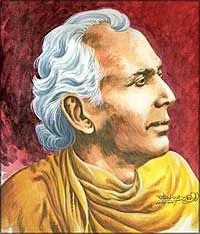
On May 25, 2025, OpIndia published a video clip (9 minutes 38 seconds) across its official social media platforms, including YouTube. The video, narrated by Ritika Chandola, falsely accuses Bodhisattva Anagarika Dharmapala of being the root cause of hatred between Buddhists and Hindus regarding the Mahabodhi Temple in Bodh Gaya.
The video also falsely claims that Anagarika Dharmapala was a “Christian devotee” who later became a Buddhist — a completely fabricated and historically inaccurate narrative. In truth, Dharmapala was born into a devout Buddhist family in Sri Lanka and remained a faithful Buddhist all his life. He committed himself fully to reviving the Buddha’s Dhamma in its ancient homeland — India.
Anagarika Dharmapala represented Buddhism at the World Parliament of Religions in Chicago, 1893, the same event where Swami Vivekananda delivered his iconic speech on Hinduism. The two spiritual giants met and developed mutual respect and friendship, united by their shared concern for India’s spiritual upliftment and global understanding of Eastern philosophies.
Anagarika Dharmapala even offered his speaking slot and time to Swami Vivekananda, recognizing the importance of his message. This generous gesture is a testimony to Dharmapala’s humility, unity, and commitment to interfaith respect — not division.
Far from promoting hatred, Dharmapala built strong relationships with key Hindu leaders. Among them:
•Sir Asutosh Mukherjee, the visionary Vice Chancellor of Calcutta University, who served as President of the Maha Bodhi Society of India
•His son, Dr. Syama Prasad Mukherjee, founder of the Bharatiya Jana Sangh (now BJP), also served as President of the Maha Bodhi Society
•Many Hindu saints, scholars, and reformers admired and supported Dharmapala’s mission to restore Buddhist sites, especially the Mahabodhi Temple, as a heritage of all Indians.
Anagarika Dharmapala was a Bodhisattva in action, and his lifelong contributions include:
•Founding the Maha Bodhi Society of India in 1891
•Restoring sacred sites like Bodh Gaya, Sarnath, and Kusinara
•Establishing schools, colleges, and orphanages for underprivileged children
•Founding charitable hospitals and dispensaries serving all communities
•Publishing Buddhist journals, reviving Pali studies, and spreading Dhamma across the world
•Promoting ethical living, non-violence, and compassion in line with the Buddha’s teachings
To portray such a noble and selfless reformer as a source of religious hatred is not only historically wrong but morally indefensible.
Dharmapala’s entire life was a mission of peace, harmony, and service — deeply rooted in India’s soil, where he spent most of his life and took his last breath in Sarnath, the land of the Buddha’s First Sermon.
